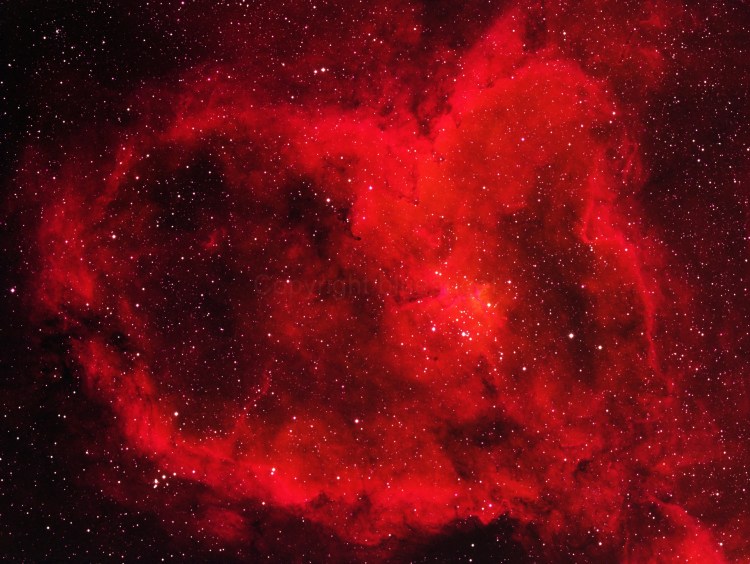
Valentines Day is closer than you think. These were taken with the Takahashi 4 inch refractor. A total of 49 thirty minute narrow band exposures were stacked to form the final images.

“It is man’s reason that lifts him to the stars.” Ayn Rand
Valentines Day is closer than you think. These were taken with the Takahashi 4 inch refractor. A total of 49 thirty minute narrow band exposures were stacked to form the final images.
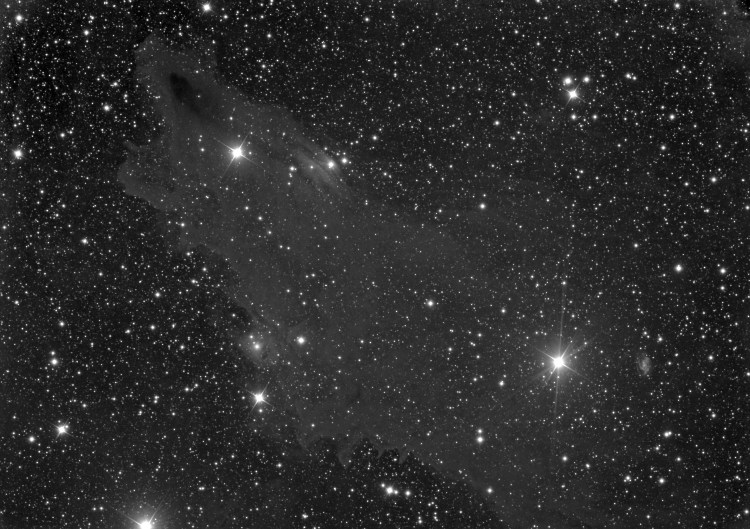
This is van den Bergh 149, a dark nebula in Cepheus. It was taken with the Takahashi FSQ106EDIII and is comprised of 38 Luminance stacked luminance images with an exposure time of 900 seconds each. Total exposure time was 9.5 hours.

I managed to reprocess this for a bit more definition. This is a faint nebula located in Taurus, about 5 degrees from the Pleiades. This was taken with a Takahashi FSQEDXIII and represents 24 hours of exposures.
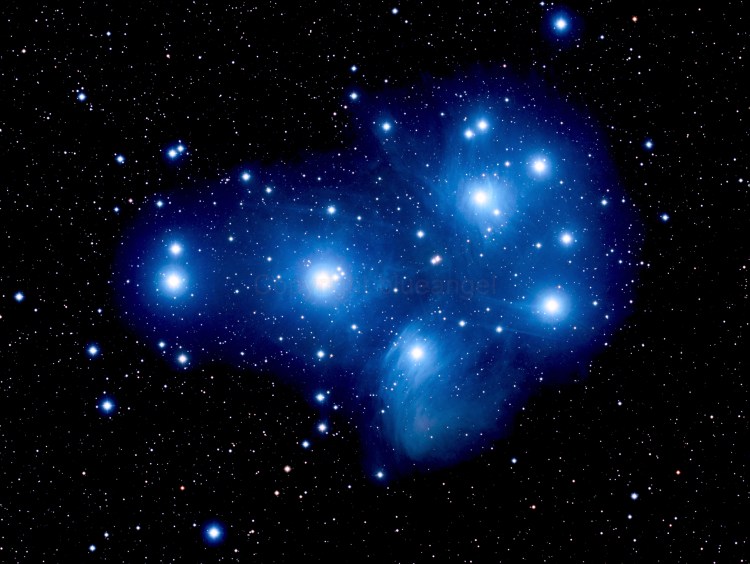 Though people sometimes refer to this open star cluster in the Constellation Taurus as the Seven Sisters, there are actually only six stars that are readily visible to most observers. Charles Messier chose it as one of his Messier objects (M45). I find it interesting that Subaru chose this grouping of stars to serve as its corporate logo.
“Subaru is the Japanese name for the Pleiades star cluster, which in turn inspires the Subaru logo and alludes to the six companies that merged to create Fuji Heavy Industries. The word ‘subaru’ means “united” in Japanese, and Fuji Heavy Industries has used the term to describe how the Pleiades constellation is a unification of the stars. Fuji Heavy Industries is therefore a constellation of companies united together.” (This was from the Stanley Subaru website http://www.stanleysubaru.com)
It seems appropriate that a Japanese telescope (Takahashi 106mm refractor) was used to image this. Sixty three 5 minute LRGB exposures were stacked to form this image.
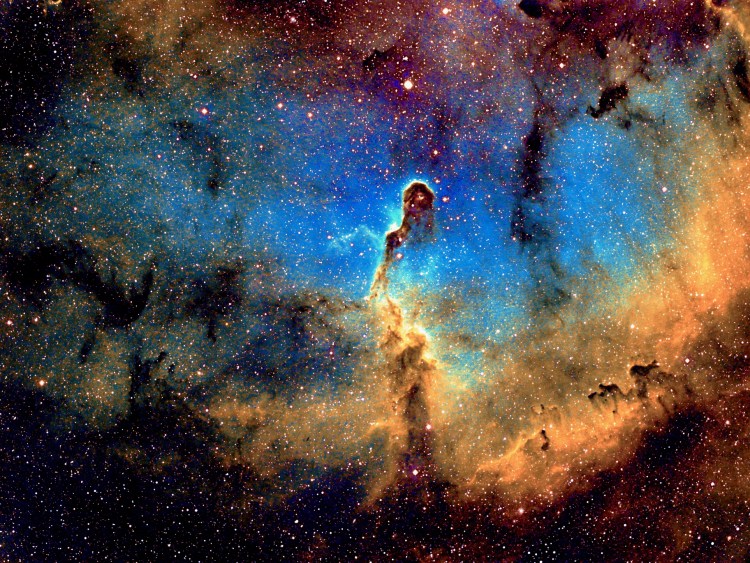
Last year I did a few pictures of the Elephant Trunk Nebula that had a smaller field of view. This is a has a wider field of view via the Takahashi 106 mm telescope. It represents 25 hours of exposures through narrowband filters.

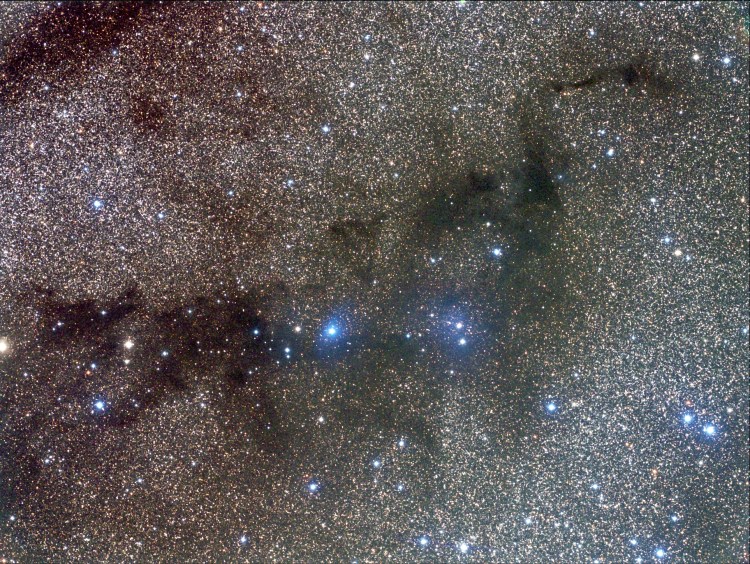
Another day, another catalog… This time we have an object that is listed in the “VDB” catalog of 159 reflection nebulae that was published in 1966 by Sidney van den Bergh. Considering the beauty of this object, further study is needed.
Sixty eight five minute LRGB images from the Takahashi FSQ106EDIII telescope were stacked and processed in Maxim DL, Pixinsight, and Photoshop.
According to Wikipedia:
“The Pelican is much studied because it has a particularly active mix of star formation and evolving gas clouds. The light from young energetic stars is slowly transforming cold gas to hot and causing an ionization front gradually to advance outward.”
“Millions of years from now this nebula may no longer be known as the Pelican, as the balance and placement of stars and gas will leave something that appears completely different.”
Compared to my previous versions of this nebula, it is a little easier to see the pelican on the left hand side of this image due to the wider field of view that is a characteristic of the Takahashi FSQ106EDXIII telescope. It was captured in narrowband filters with 20 Sulphur, 17 Hydrogen-Alpha, and 16 Oxygen stacked images mapped to Red, Green and Blue as in the Hubble Palette.

Lynds original catalog of dark nebulae was published in 1962. The catalog contains dark nebulae that were identified by Lynds’ visual inspection of the Palomar-Schmidt photographs. The clouds had to be visible on the red and blue photographs to be recorded. The original catalog contained 1802 objects. LDN 1251 is a Dark Nebula in the Constellation Cepheus. This image is a composite of 69 fifteen minute LRGB images photographed through a 106mm Takahashi Telescope.

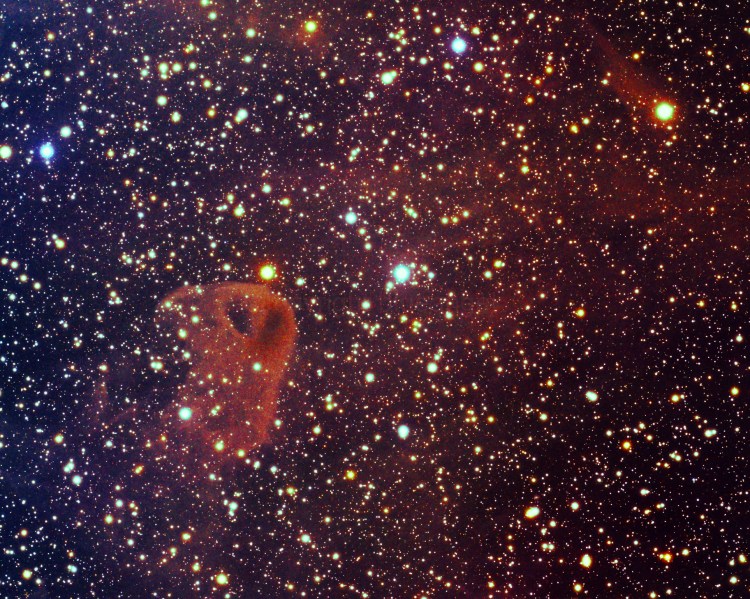
This nebula is at a distance of about 400 light years and is fairly difficult for astrophotographers to capture. It is difficult to tease the eagle out of the background stars. This was taken through a Takahashi 106mm telescope through RGB filters. The imaging time was 24 hours.
 Astro La Vista Observatory